Do Monocytes Read High When Getting Radiation Treatment
This data will help you prepare for radiation therapy to your brain, including what to expect earlier, during, and after your handling. You lot'll besides acquire near side effects and how to intendance for yourself during your handling.
Nosotros suggest you read through this at least once before you starting time radiations therapy, and so use information technology as a reference in the days leading upward to your radiations treatments then that yous can do all yous tin to set up. Bring information technology with you for your simulation appointment and all time to come appointments with your radiations oncologist and so you lot and your healthcare squad can refer to it.
Back to topAbout Radiation Therapy to the Brain
Radiation therapy uses high-energy rays to care for cancer. It works past damaging the cancer cells and making information technology difficult for them to reproduce. Your trunk so is naturally able to get rid of these damaged cancer cells. Radiation therapy too affects normal cells. However, your normal cells are able to repair themselves in a fashion that cancer cells tin't.
Radiation can be given to treat primary tumors in your brain or tumors that take spread to your brain from another part of your trunk (metastasized). Your doctor volition decide whether you'll receive fractional or whole brain radiation. You'll have either external beam radiation therapy or stereotactic radiosurgery depending on your treatment plan.
During external beam radiation, a treatment motorcar will aim beams of radiation directly to the tumor. The beam passes through your torso and destroys cancer cells in its path. You lot won't meet or feel the radiation.
Stereotactic radiosurgery can be used in some tumors and is even more than precise. It targets a pocket-size area in your brain with loftier doses of radiation and delivers lower doses of radiations to the normal tissue around it. You're able to receive higher doses to the tumor at each handling session, which shortens the overall course of handling.
Radiation therapy takes time to work. It takes days or weeks of treatment before cancer cells start to die, and they keep dying for weeks or months after radiation therapy.
Back to elevationYour Function on Your Radiation Therapy Team
You'll have a team of healthcare providers working together to provide the correct intendance for you. You lot're a part of that team, and your function includes:
- Arriving on time for all your radiation therapy sessions.
- Asking questions and talking about your concerns. We've included a list of possible questions at the terminate of this resource.
- Letting someone on your radiation therapy squad know when yous accept side furnishings.
- Telling your doctor or nurse if yous're in pain.
- Caring for yourself at home:
- Quitting smoking, if yous smoke. If you lot desire to quit, telephone call our Tobacco Treatment Program at 212-610-0507.
- Following your radiation therapy team'southward instructions to intendance of your skin.
- Drinking liquids every bit instructed past your healthcare team.
- Eating the foods suggested past your radiations therapy team.
- Maintaining your weight.
Simulation
Before you brainstorm your handling, you'll take a treatment planning procedure called a simulation. This is done to make sure that:
- Your treatment site is mapped.
- Y'all become the right dose of radiation.
- The amount of radiations that gets to your nearby tissues is equally small equally possible.
During your simulation, you'll take imaging performed and your skin will be marked with piddling tattoo dots. These marks place the area that volition exist treated. These may or may non be used in your treatment programme. If y'all take concerns nearly tattoos as part of your treatment please discuss this with your physician.
Your simulation will take two hours, but can be longer depending on the treatment your physician has planned for you lot.
Preparing for your simulation
No special preparation is needed before your simulation. Y'all can eat and drink as you ordinarily would on the twenty-four hours of your procedure.
Depending on your treatment plan, you may need more than detailed imaging, including magnetic resonance imaging (MRI) which will be used to help plan your treatment.
During your simulation, y'all'll exist lying in one position for a long time. If you call back you'll be uncomfortable lying still, you tin take acetaminophen (Tylenol®) or your usual hurting medication earlier your simulation. If yous call up you may get anxious during your procedure, speak with your doctor nigh whether medication may exist helpful.
Wear comfortable clothes that are easy to take off because you may need to change into a hospital gown. Don't habiliment jewelry, powders, or lotions.
Remove devices from your skin
If you lot wear whatever of the following devices on your skin, the manufacturer recommends y'all remove it before your simulation or treatment:
- Continuous glucose monitor (CGM)
- Insulin pump
Talk with your radiations oncologist most whether y'all may need to remove your device before your simulation or treatment. Make certain you lot have an extra device with you lot to put on after your simulation or handling.
If you're non sure how to manage your glucose while your device is off, talk with the healthcare provider who manages your diabetes care earlier your appointment.
Day of your simulation
What to expect
A member of your radiation therapy team will check you in. You'll be asked to state and spell your total proper name and nascency appointment many times. This is for your safe and part of our standard identification procedure. Patients with the same or similar names may be having intendance on the aforementioned day as yous.
You'll exist greeted by your radiation therapist. They'll take a photograph of your face. This picture will be used to identify you lot throughout your treatment.
Your therapist will then explain the simulation to yous. If yous haven't already signed a consent course, your radiation oncologist will review everything with you lot, and ask for your signature.
During your simulation
For your simulation, you may need to get undressed and change into a gown. Yous should keep your shoes on. If you lot wear a caput covering, such as a wig, turban, or cap, you may take to remove information technology. Your therapists will assist you lie down on a table and make every endeavour to ensure your comfort and privacy.
Although the table will take a sail on it, it'southward difficult and has no cushion. If you haven't taken pain medication and recall you may need it, tell your therapists earlier your simulation begins. Also, the room is commonly cool. If yous experience uncomfortable at whatsoever time, let your therapists know.
Throughout your simulation, you'll feel the table motility into different positions. The lights in the room will exist turned on and off and you'll see ruddy light amplification by stimulated emission of radiation lights on each wall. Your therapists use these laser lights as a guide when they position you on the table. Don't look directly into the red axle considering information technology may damage your optics.
Although your therapists will walk in and out of the room during your simulation, there will ever be someone who tin meet and hear you. You'll hear your therapists speaking to each other as they work, and they'll explain to you what they're doing. Don't motility one time your simulation begins, because it may alter your position. However, if yous're uncomfortable or need help, tell your therapists.
To help laissez passer the fourth dimension, your therapists can play music for you. You may bring a CD of your own from home, if yous wish.
Positioning
Your therapists will help you lot prevarication down on the tabular array. You'll be lying on your back during your simulation and each treatment. To help you stay in the correct position, yous'll vesture a mask or chin strap. Your therapists will make this for yous.
To make the mask, your therapist will place a warm, moisture sail of plastic mesh over your face while yous're lying on the simulation table. They'll so shape it to fit around your caput (run across Figure one). You won't accept whatsoever trouble hearing or seeing while the mask is on.
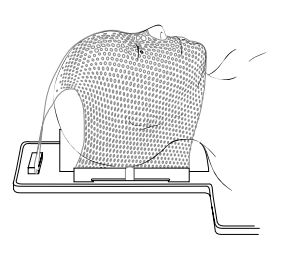
Figure one. Mask for your radiation
Markings will exist made on the mask. After the mask is made, your therapists will take several photographs of you in your simulation position. The photographs and markings will exist used equally guides to position you lot correctly for your treatments. This part of your simulation takes about fifteen minutes.
Sometimes, a mentum strap is made instead of a mask. Information technology'due south a piece of fabric that's placed under your chin to hold your caput in place (see Figure ii). It will be secured to the tabular array on which you're lying. Like the mask, it ensures that you're in the right position during your simulation and treatments.

Effigy ii. Chin strap for your radiation
If you're having stereotactic radiosurgery, a special mold will be made of your head and shoulders. Once it dries your therapist will make a mask by placing a warm sheet of mesh over your face up that will have an opening (meet Figure iii).
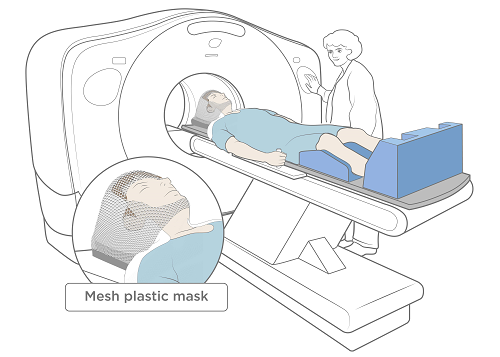
Figure 3. Computed Tomography (CT) scan with open face up mesh mask
Pare markings (tattoos)
If you lot take a chin strap, your therapists volition draw on your peel with a felt marker. You may demand 2 permanent skin markings called tattoos, i on either side of your head, above your ears. The sensation of getting one feels like a pinprick. The tattoo marks are no bigger than the head of a pin. The felt markings can be washed off after your simulation. The tattoos are permanent and won't wash off. If you're concerned near receiving tattoos every bit part of your radiation treatment, talk with your doctor.
After the tattoos are made, your therapists volition accept several photographs of you lot in your simulation position. The photographs and tattoo marks volition be used as guides to position yous correctly each day of your treatment.
Imaging
While you're lying in your position, you'll get scans of the area to exist treated. These images will be done on an x-ray machine chosen a simulator or on a computed tomography (CT) scan machine (see Figure iii). These scans are used only to map your treatment. They aren't used for diagnosis or to find tumors. If you demand other imaging, your nurse will explain this to you.
Occasionally, your nurse may start an intravenous (IV) line so that dissimilarity (dye) can be given to you before your scan. The dissimilarity helps the states go clear images of the area to be treated. If you're allergic to dissimilarity, please tell your doctor or nurse.
Information technology volition take about 45 minutes to get your browse. During the scan, you'll hear the machine turn on and off. Even if the dissonance seems loud, your therapists will be able to hear you if you speak with them.
Back to topAfter Your Simulation
At the end of your simulation, we will requite yous an engagement for your gear up-up procedure and treatment.
Scheduling your treatment
Radiations treatments may be given Monday through Fri. For some people, the treatment is given in just one day. For other people, the treatment is given over a number of weeks. Your schedule is based on what your doctor recommends.
Your treatment may exist given in several different schedules. It can be:
- A unmarried treatment, normally given on the same solar day as your set-up or beam films
- 3 to 5 treatments: ________________________________________
- Daily treatment, given Monday through Friday, for about _____ weeks.
You must come in every twenty-four hours that yous're scheduled for your treatment. Treatment may not be as effective if y'all skip or miss appointments. If for some reason y'all can't come in for treatment, you must phone call your radiation oncologist's office to allow your team know. If you need to change your schedule for any reason, speak with your radiations therapist.
If y'all're receiving stereotactic radiosurgery, your radiation oncology team will tell yous well-nigh the length of your appointment times and this will vary depending on how many sites are being treated.
Handling planning
During the fourth dimension between your simulation and beginning of treatment, your radiation oncologist will piece of work with a team to plan your treatment. They'll use your simulation images to plan the angles and shapes of your radiations beams. The details are carefully planned and checked. This takes 1 to 10 days.
Vitamins and dietary supplements
You may take a daily multivitamin during radiations therapy, if yous wish. Don't take more than the recommended daily allowance of whatsoever vitamin. Don't take whatever other vitamins or any supplements without talking to your doc. This includes both nutritional and herbal supplements.
Dorsum to topSet-up Procedure
Before your outset treatment, you'll exist scheduled for a prepare-up procedure. This process unremarkably takes about 1 hour. If pain medication was helpful during simulation, you lot may want to take it earlier this process.
When you come for your set up process, you'll be shown to the dressing room and asked to change into a gown. Your therapists volition bring y'all to the room where you'll receive your treatment each day. They'll position you lot on the table. You'll lie on your dorsum exactly as you did during your simulation.
Special ten-rays called beam films will be taken to make sure that your position and the area beingness treated are correct. The beam films will be repeated throughout your treatment. They aren't used to come across how your tumor responds to the handling.
Depending on your handling programme, you lot may start handling on the same day every bit your set up procedure or on the next concern day.
Back to superlativeDuring Your Handling
After you check in at the reception desk, accept a seat in the waiting room. When your radiation therapists are ready for yous, they'll tell you to change into a gown. You should proceed your shoes on during the treatment.
Your radiations therapists will bring y'all into the treatment room and help you lie on the table (see Figure 4). You'll exist positioned exactly how yous were lying during your set-up procedure.
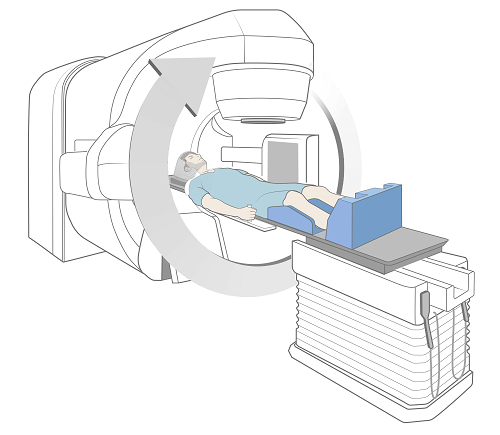
Figure 4. During your handling
Once you're positioned correctly, your radiation therapists will go out the room, close the door, and brainstorm your treatment. You won't meet or feel the radiations, but you lot may hear the automobile as it moves around you and is turned on and off. You'll be in the treatment room for 15 to 90 minutes, depending on your treatment plan. Most of this time will be spent putting you in the correct position.
Although you lot'll be solitary during the treatment, your radiations therapists will run across yous on a monitor and hear you through an intercom at all times. Your radiation therapists volition brand sure that you're comfortable during the handling. Breathe normally during the treatment, just don't movement. However, if yous're uncomfortable or need help, speak to your radiations therapists. They tin can turn off the auto and come in to see you at whatever time, if necessary.
Neither you nor your wearing apparel volition become radioactive during or later on treatment. It's safe for you to be around other people.
Discharge instructions subsequently stereotactic radiosurgery
If you're having stereotactic radiosurgery, you lot'll need to follow special instructions.
- You'll need to take a resposible intendance partner take yous home later on your treatment. Don't drive for ____________.
- Your intendance partner volition need to stay with you for the outset 24 hours later on your treatment.
- Yous tin can resume virtually of your activities the day after your treatment. Ask your doctor or nurse when you can resume vigorous exercise.
Scheduled visits during treatment
Your radiations oncologist and radiations nurse will see you for a scheduled visit during your treatment course to talk with you about whatever concerns, ask about any potential side effects you lot may be having, and answer your questions. This visit will be before or later your treatment on __________________. You should plan on beingness at your appointment about 1 actress hour on this day.
Your radiations oncologist and radiation nurse will meet you for a scheduled visit during your treatment grade to talk with y'all near any concerns, ask nearly whatever potential side furnishings you may be having, and answer your questions. This visit will be earlier or afterwards your treatment on __________________. You should program on being at your appointment nearly 1 extra hour on this day.
If yous need to speak with your radiation oncologist or radiation nurse any fourth dimension between your visits, phone call your radiation oncologist'southward office or ask the support staff or your radiation therapists to contact them when you come up in for treatment.
Back to topSide Effects
Some people may develop side effects from radiation therapy. Which side effects and how astringent they are depend on many factors, such every bit the dose of radiation, the number of treatments, and your overall health. Side effects may be worse if you're as well getting chemotherapy. Below are the most common side effects of radiation therapy to the brain. Y'all may take all, some, or none of these.
Swelling in your brain
Radiation therapy to the brain may cause brain swelling. If you had neurological symptoms before y'all began radiation therapy, they could return, or you could accept new symptoms. These symptoms may include:
- A worsening of your original symptoms
- Seizures
- A headache that doesn't go abroad after taking acetaminophen (Tylenol®)
- Nausea and airsickness
- Changes in vision, such every bit double vision
- Unsteadiness when walking
- Change in mental condition
If you have any new or worsening symptoms, call your doctor or nurse right away. They'll want to evaluate you. Medication(s) tin can exist prescribed if needed. These may include:
- Steroids, such as dexamethasone (Decadron®). Steroids reduce brain swelling from the tumor itself or from the effects of radiation therapy.
- Take steroids but every bit directed by your doctor. You dose may be changed as needed during your treatment. When your medico decides information technology'due south safe, yous'll be given a schedule to gradually reduce the dose of the medication. Do non finish taking dexamethasone unless instructed by your doctor.
- Steroids tin can cause tum hurting, so always have them with nutrient. You may be given another medication to reduce the take a chance of stomach irritation.
- Steroids can increment the risk of sure lung infections. You may be given an antibiotic called sulfamethoxazole and trimethoprim (Bactrim®) to reduce this risk.
- Steroids may mask signs of infection, such as fever.
- Steroids tin can increment your blood sugar. If yous accept diabetes, please tell your radiation therapy squad and the doctor who prescribes your medications for diabetes.
- Medications to control seizures, such every bit levetiracetam (Keppra®), phenytoin (Dilantin®), carbamazepine (Tegretol®), phenobarbital (Luminal®), or valproic acid (Depakene®).
- If y'all're taking any of these antiseizure medications, you may need to accept blood tests to brand sure y'all're receiving the right dose.
- Speak with your doctor well-nigh whether or non it's safe for yous to bulldoze while taking these medications.
Hair loss
Two to iii weeks later on your radiation therapy begins, you'll probably lose some of the hair on your scalp. Inquire your doctor or nurse what to expect. Your hair will usually grow dorsum 3 to vi months after your treatment is completed.
The color and texture of your hair may be different after your radiation therapy. You tin cover your scalp with a scarf, turban, wig, or toupee if it makes you experience more comfortable.
If you want to wear a wig or hairpiece, attempt to get one earlier your hair falls out because it will be easier to lucifer your pilus color and style. Your health insurance may comprehend the price of your wig or hairpiece. For your wig or hairpiece to exist covered past insurance, your doctor must write a prescription with a diagnosis code indicating that your hair loss is due to treatment for cancer. Check with your insurance company to meet if they comprehend the costs of wigs or hairpieces and how much they'll pay.
Pilus care
- Gently launder your hair with a mild shampoo when needed.
- Use a soft-bristle brush on your pilus.
- Don't dye your hair or use hair products.
Pare reactions
During radiation therapy, your skin and hair in the area being treated may change. This may include your forehead, ears, and back of your neck. This is normal. Ask your nurse to point out the areas of your skin and scalp that volition be affected.
After 2 or 3 weeks, your peel may become pinkish or tanned. It may even become bright red or very dark later on. It may also experience dry and itchy and look flaky. These symptoms will gradually decrease about 3 or 4 weeks afterwards you finish your treatments.
You may likewise find a rash, especially in any area where you have had previous sunday exposure. Although this may be a side effect of treatment, a rash could as well be a sign of infection. If yous develop a rash at any time during your treatment, tell your doctor or nurse.
Below are guidelines to help yous intendance for your skin during treatment. Follow these guidelines until your skin gets ameliorate. These guidelines refer simply to the skin in the area being treated with radiation therapy.
Keep your skin clean
- Bathe or shower daily using warm water and a balmy unscented soap, such as Pigeon®, Basis®, or Cetaphil®. Rinse your skin well and pat it dry with a soft towel.
- When washing your hair, be gentle with your skin and scalp. Don't utilize a washcloth, a scrubbing cloth, or castor.
- Don't use alcohol or booze pads on your skin in the area being treated.
Moisturize your skin oftentimes
- Your nurse may suggest that you start using a moisturizer on the first mean solar day of your handling. If you aren't likely to develop a skin reaction, you don't need to use a moisturizer unless your skin becomes dry or itchy. You tin use over-the-counter moisturizers. When choosing a moisturizer pick ane that doesn't have whatsoever fragrances or lanolin. There are a number of products that are expert to employ, and your nurse may suggest one of these to yous. Utilise just i at a time unless your nurse tells you to utilise more.
- If y'all're using a moisturizer, utilize information technology 2 times a 24-hour interval.
Avoid irritating your pare in the expanse being treated
- Don't vesture tight caps or turbans that will rub against your skin.
- Utilize only the moisturizers, creams, or lotions that you accept discussed with your dr. or nurse.
- Don't use makeup, perfumes, powders, or aftershave in the area being treated.
- Don't put tape on your treated skin.
- If your skin or scalp is itchy, don't scratch it. Use moisturizer. Enquire your nurse for recommendations on how to relieve the itching.
- Don't shave in the surface area that is being treated. If you must shave, employ only an electrical razor. Stop if your peel becomes irritated.
- Don't let your treated skin come into contact with extreme hot or cold temperatures. This includes hot tubs, water bottles, heating pads, and ice packs.
- If yous have no skin reactions during your treatment, you lot can swim in a chlorinated pool. However, be sure to rinse off the chlorine right subsequently getting out of the puddle.
- Avoid tanning or burning your skin during handling and for the rest of your life. If you're going to be in the sunday, use a PABA-gratis sunblock with an SPF of 30 or college. Also, wear loose-fitting wearable that covers you every bit much as possible.
Fatigue
Fatigue is a feeling of being tired or weak, not wanting to do things, non being able to concentrate, or feeling slowed down. Yous may develop fatigue after 2 to 3 weeks of handling, and it tin can range from mild to severe. Fatigue may last 6 weeks to 12 months afterward your treatment ends.
There are a lot of reasons why you may develop fatigue during treatment, including:
- The furnishings of radiation on your body.
- Traveling to and from treatment.
- Non having enough restful sleep at night.
- Not eating plenty protein and calories.
- Having hurting or other symptoms.
- Feeling anxious or depressed.
- Certain medications.
You may detect that your fatigue is worse at certain times of the day. Below are suggestions to help you manage your fatigue.
Ways to manage fatigue
- If y'all're working and are feeling well, go along to do so. However, working less may help increment your energy.
- Plan your daily activities. Pick those things that are necessary and about important to yous and practice them when yous have the most energy. For example, you lot may go to work merely not do housework, or lookout man your children's sports issue but non go out to dinner.
- Plan time to residuum or accept brusque naps (10 to 15 minutes) during the day, especially when you experience more tired. If you do nap, try to sleep for less than 1 hour at a time.
- Attempt to sleep at least 8 hours every night. This may be more sleep than yous needed before y'all started radiations therapy. You may also observe information technology helpful to go to sleep earlier at night and become up later in the morning. One way to sleep improve at dark is to be active during the day. For case, if you're able to do, yous could go for a walk, do yoga, or ride a bike. Another way to sleep better at nighttime is to relax before going to bed. Y'all might read a book, work on a jigsaw puzzle, listen to music, or do calming hobbies.
- Ask family and friends to assistance you with things like shopping, cooking, and cleaning. Bank check with your insurance visitor to see if they encompass domicile care services.
- Some people accept more energy when they exercise. Enquire your doctor if you can do light exercise, such as walking, stretching, or yoga.
- Eat foods that are high in protein and calories. Ask your nurse for the resource Eating Well During Your Cancer Treatment.
- Other symptoms, such as pain, nausea, diarrhea, difficulty sleeping, or feeling depressed or broken-hearted, can increase your fatigue. Enquire your physician or nurse for help with whatsoever other symptoms yous may accept.
Sexual health
You might have concerns about how cancer and your treatment can affect your sexuality. You aren't radioactive. Yous can't pass radiation to anyone else, then it'south prophylactic to be in shut contact with other people.
Y'all can be sexually active during radiation treatment, unless your radiations oncologist gives you other instructions. Yet, if you lot or your partner are able to have children, you must use nascence control (contraception) to preclude pregnancy during your treatment.
The American Cancer Society has resources about sexual health bug during cancer handling chosen Sexual activity and the Adult Male person with Cancer and Sex and the Woman with Cancer. You can search for them at www.cancer.org or telephone call 800-227-2345 for a re-create.
MSK also has sexual health programs to assistance you address the affect of your disease and treatment on your sexual health. You can meet with a specialist before, during, or subsequently your treatment.
- Female Sexual Medicine & Women'south Health Program: For more information or to make an appointment, call 646-888-5076.
- Male Sexual & Reproductive Medicine Plan: For more information or to make an date, call 646-888-6024.
Emotional health
Cancer diagnosis and treatment tin be very stressful and overwhelming. You might feel:
|
|
|
All of these types of feelings are normal if you or someone you love has a serious illness.
You might also worry about telling your employer that you take cancer or about paying your medical bills. Y'all might worry well-nigh how your family relationships might modify, about the upshot of cancer treatment on your body, or if you'll continue to be sexually attractive. Y'all might worry that the cancer will come back. We're here to support y'all.
Ways to cope with your feelings
- Talk with other people. When people try to protect each other by hiding their feelings, they can feel very lone. Talking can assist the people around y'all know what y'all're thinking. It might assistance to talk about your feelings with someone yous trust. You can talk with your spouse or partner, a close friend, family unit fellow member, chaplain, nurse, social worker, or psychologist. Y'all might too find information technology helpful to talk to someone who'due south going through radiation therapy, or a cancer survivor or caregiver who has been through a similar treatment. Through our Patient and Caregiver Support Plan, you have a chance to speak with erstwhile patients and caregivers. To acquire more nearly this service, call 212-639-5007.
- Join a support grouping. Coming together other people with cancer volition give you lot a chance to talk about your feelings and listen to other people who take the same concerns. You'll learn how others cope with their cancer and treatment. Your doctor, nurse, or social worker can tell y'all almost the support groups you might exist interested in.
- Effort relaxation and meditation. Yous might try thinking of yourself in a favorite place while breathing slowly, paying attention to each breath, or listening to a soothing music or sound. For some people, praying is some other form of meditation. These kinds of activities tin help you feel relaxed and calm.
- Practise. Many people find that calorie-free activity like walking, biking, yoga, or water aerobics helps them feel meliorate. Talk with your doctor or nurse about types of exercise you can do.
We all have our own way of dealing with difficult situations. By and large, we use any has worked for united states of america in the past. However, sometimes this isn't enough. Nosotros encourage you to speak with your doctor, nurse, or social worker well-nigh your concerns.
Dorsum to topAfter Your Treatment
Please be sure to go along your follow-upwards appointments with your radiation oncologist. He or she will evaluate your response to treatment. You may accept blood tests, x-rays, and scans during these visits. Earlier coming, write down your questions and concerns. Bring this and a list of all your medications with you. Y'all can also call your doctor or nurse at any time after your treatment is completed, or in between follow-up visits, if you accept whatever questions or concerns.
Back to topContact Information
If you have any questions or concerns, talk with a member of your radiation therapy team. You can reach them Monday through Friday from to at the numbers listed below.
Radiation oncologist: _____________________
Phone number: _________________________
Radiations nurse: ________________________
Telephone number: _________________________
Afterwards , during the weekend, and on holidays, call 212-639-2000. Inquire for the radiation oncologist on call.
Resource
Many of the resources listed in this guide can be found on the Internet. If you don't have a computer or if you don't know how to utilize the Internet, check with your local public library or customs eye.
MSK support services
Counseling Centre
646-888-0200
Many people observe that counseling helps them. Nosotros provide counseling for individuals, couples, families, and groups, every bit well as medications to help if y'all experience broken-hearted or depressed.
Female person Sexual Medicine & Women'south Health Program
646-888-5076
This program helps female patients who are dealing with cancer-related sexual health challenges, including premature menopause and fertility issues.
Integrative Medicine Service
646-888-0800
MSK's Integrative Medicine Service offers patients many services to complement traditional medical care. These include music therapy, listen/body therapies, dance and move therapy, yoga, and bear upon therapy.
Male Sexual & Reproductive Medicine Program
646-888-6024
This programme helps male person patients who are dealing with cancer-related sexual wellness challenges, including erectile dysfunction.
Nutrition Services
212-639-7312
MSK's Nutrition Service offers nutritional counseling with one of our certified dietitians. Your dietitian volition review your electric current eating habits and give advice on what to eat during and later treatment.
Patient and Caregiver Support Program
212-639-5007
You might find it comforting to talk with a cancer survivor or caregiver who has been through a like treatment. Through our Patient and Caregiver Support Program, nosotros're able to offer you a chance to talk with old patients and caregivers.
Resources for Life After Cancer (RLAC) Programme
646-888-8106
At MSK, intendance doesn't terminate afterward agile treatment. The RLAC Programme is for patients and their families who accept finished treatment. This plan has many services, including seminars, workshops, support groups, counseling on life after treatment, and help with insurance and employment issues.
Tobacco Treatment Program
212-610-0507
If you desire to quit smoking, MSK has specialists who can assist. Phone call for more information.
External resource
American Cancer Society (ACS)
www.cancer.org
800-ACS-2345 (800-227-2345)
Offers a variety of information and services, including Promise Lodge, a free place for patients and caregivers to stay during cancer treatment.
American Gild for Therapeutic Radiology and Oncology
www.rtanswers.org
800-962-7876
A group of radiation oncology professionals that specializes in treating patients with radiation therapy. Provides detailed information on treating cancer with radiation and contact information for radiations oncologists in your area.
CancerCare
www.cancercare.org
800-813-HOPE (800-813-4673)
275 Seventh Avenue (Between West 25thursday & 26thursday Streets)
New York, NY 10001
Provides counseling, support groups, educational workshops, publications, and financial assist.
Cancer Back up Community
world wide web.cancersupportcommunity.org
Provides support and pedagogy to people affected by cancer.
National Cancer Institute (NCI) Cancer Information Service
www.cancer.gov
800-4-CANCER (800-422-6237)
Provides education and support to people with cancer and their families. Publications are bachelor online and in print.
Questions to Enquire Your Healthcare Provider
Before your appointment, it's helpful to write down the questions y'all want to inquire your healthcare provider. Examples of questions you can enquire are listed below. Write down the answers during your appointment so you lot can review them later.
What kind of radiation therapy volition I go?
How many radiation treatments volition I go?
What side effects should I look during my radiation therapy?
Volition these side effects get away after I finish my radiations therapy?
What kind of belatedly side effects should I expect later on my radiation therapy?
Back to heightespinozatheighavell.blogspot.com
Source: https://www.mskcc.org/cancer-care/patient-education/radiation-therapy-brain
0 Response to "Do Monocytes Read High When Getting Radiation Treatment"
Post a Comment