Peer Reviewed Research Articles Opioid Abuse and Crime Relationship
The influence of family and peers on adolescent substance abuse has been well documented in the scientific literature. Generally, positive family unit influences, such equally family bonding and consistent rules, announced to reduce the risk of tobacco, marijuana, and other drug abuse among teens, while negative family unit influences tend to increase risk. The same is truthful of positive and negative peer factors. Little inquiry, however, has been conducted to see how parental and peer factors interact to influence adolescents' initiation to and immature adults' employ of drugs.
Two new NIDA-funded studies--one looking at initiation of substance use, the other at continued substance abuse--evidence that some aspects of family and peer influences remain stiff from early initiation into immature adulthood and across socioeconomic, ethnic, and gender lines. Both studies yielded surprises and implications for intervention. For example, the first study plant that although family and peer factors had similar effects on males and females, family monitoring and rules had a stronger protective effect for males than females. The 2d written report found that for either gender, peer influence was not mediated by the quality of the relationship, except for female peer influence on young adult marijuana utilize.
Impact of Family on Teens' Initiation to Drugs
University of Washington researchers recruited 808 5th-graders from xviii Seattle uncomplicated schools in high-crime areas and followed them from ages 12 to 21 to see how peer, family, and sociodemographic factors interacted to influence drug initiation.
As role of an ongoing NIDA report directed by Dr. J. David Hawkins, information from this grouping were gathered annually through historic period 16 and again at 18 and 21. The sample included a loftier proportion of low-income families, "but not all children came from homes in loftier-risk neighborhoods," says Dr. Karl Hill, one of the study'southward authors. Of concern were the extent of bonding to family unit, family involvement (fourth dimension spent interacting with parents), family conflict resolution and parenting practices (monitoring, rules, and consistent bailiwick), peers' prosocial and antisocial activities, and measures of apply for tobacco, marijuana, cocaine, amphetamines, tranquilizers, sedatives, and psychedelics.
Initiation of illicit drug use for the entire study grouping was 4.half dozen percent by age 12, 8.4 percent past age 13, 12.6 percent by age eighteen, and 40.5 percentage by historic period 21. Past age 21, 45.iv percentage of male participants had initiated illicit drug utilize, every bit had 35.five percent of females. Native Americans had the highest charge per unit of initiation, at 55.ix per centum, compared to 53.6 per centum of European Americans, 33.3 percentage of African Americans, and 14.six percent of Asian Americans.
All of the measured family factors were influential, with the terms low level referring to families in the everyman 10 percentage for a specific factor and loftier level referring to those in the highest 10 per centum. Higher levels of family monitoring and rules were associated with a "significantly" lower hazard of illicit drug initiation, co-ordinate to Dr. Hill. For example, youths with low levels of family monitoring and rules at historic period xviii were twice as likely (xiv percent versus 7 percent) to initiate illicit drugs as those with high family unit monitoring. The same was true for a higher level of moderate and consistent family discipline--youths with low consequent family unit subject area were over twice as probable (15 per centum versus 6 percent) at age xviii to initiate illicit drugs every bit those with high consistent family discipline.
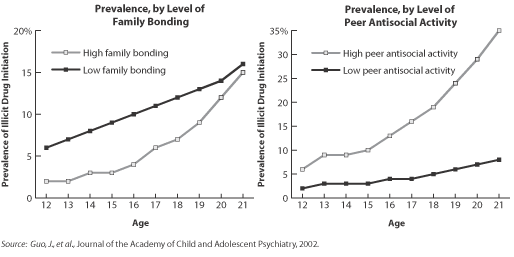 Family Bonding and Peer Antisocial Activity Touch Drug Initiation Amid Adolescents. Depression levels of family bonding and high levels of peer antisocial activity were consistently associated with higher prevalence of illicit drug initiation amid youths ages 12 to 21 compared with prevalence seen when loftier levels of family unit bonding and low levels of peer antisocial activity were present. Past age 21, however, a high level of family unit bonding had far less impact than in earlier years on adolescent drug initiation.
Family bonding was peculiarly influential before the historic period of 18--youths with depression family bonding at historic period fifteen were three times more than likely (9 per centum versus 3 per centum) to initiate illicit drugs than those with high family bonding. Higher levels of family conflict were associated with a higher chance of initiation. For instance, youths with high family conflict at age 18 were over twice every bit likely (15 percent versus half-dozen percent) to initiate illicit drugs equally those with low family disharmonize. Loftier levels of peer antisocial activity, particularly afterward historic period 15, constitute youths at historic period 18 near 4 times every bit likely (nineteen percent versus 5 pct) to initiate illicit drugs as those with low hating peer influence (in the bottom 10 percentage).
Family monitoring and rules seemed to reduce the risk of initiation primarily by affecting the child'southward choice of peer groups. "Some family factors operate through peers and some are contained of peer groups," Dr. Loma explains. "Kids with depression bonding to parents are more than likely to get involved with narcotics and stimulants, even if they don't hang out with bad peers. Then you lot stop up with this set of independent risks with high family disharmonize, low bonding, and bad peer involvement. All these things stack the deck toward initiation of serious drug use.
"In full general, family and peer factors had similar effects on boys and girls," Dr. Hill observes. "Just family monitoring and rules had a stronger protective effect for males than for females." Family monitoring and bonding were more than predictive for European Americans than for African Americans. Otherwise, says Dr. Hill, "family and peer factors affecting illicit drug initiation were similar across gender and ethnic groups."
The message is clear: Family factors matter. "The impact of simply one factor--family bonding--begins to decline afterwards age 18," Dr. Hill says. Peer factors besides matter. Having antisocial peers, peculiarly afterward age 15, increases the risk of drug initiation. "Both sets of influences contribute," he says, "even after decision-making for sociodemographic groundwork and prior alcohol, tobacco, and marijuana initiation."
In terms of intervention, "family and peer factors should exist important targets for preventive efforts," Dr. Hill says. The endeavour should first early on and proceed into the twenties, emphasizing family bonding early and family monitoring, rules, and reduction of conflict throughout. "Programs that address these family and peer factors should work relatively well across gender and indigenous groups," he concludes.
Influence of Peers on Young Adults' Substance Abuse
Another NIDA-funded study took a slightly different path, looking at peer influence on young adults. Equally office of a long-range report led by Dr. Hyman Hops of the Oregon Inquiry Institute in Eugene, Oregon, the researchers gathered information from 294 participants ages 19 to 25. Each participant brought i same-sex and ane reverse-sexual practice peer into the report; those who were married brought their marital partner as their opposite-sex peer. Data gathered annually for 3 years included the quality of these relationships, the extent of whatever substance abuse, and the problems associated with drug use.
At the beginning of the study, 30 percent of the 294 participants had smoked cigarettes, 29 percentage had smoked marijuana in the previous month, x pct had used other illicit drugs, and 41 percent reported problems associated with drug utilize in the previous 12 months. Thirty-nine per centum had not used any drugs in the catamenia specified. Men who smoked marijuana did so, on average, more ofttimes than female marijuana smokers did--an boilerplate of five.5 times per month versus women's boilerplate of 2.vii times a month. "Other differences betwixt genders were not meaning," says Dr. Judy Andrews, lead author of the Oregon team. "Correlations between diverse substances were moderate."
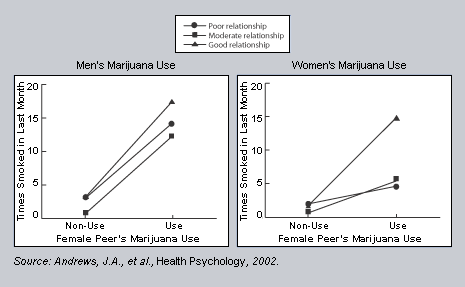 Quality of Female Peer Relationship Impacts Young Developed Marijuana Utilise. Each participant brought one same-sexual practice and one contrary-sex peer into this written report; participants who were married brought their spouse as their opposite-sex peer. The quality of the relationship with a female person peer was a factor in young adults' marijuana use; with young adults' apply of other substances, all the same, the quality of the peer relationship was non a factor.
Apply of drugs by male peers positively influenced subsequent utilise past both men and women. "I expected females, in full general, to be more than influenced past males than past females," Dr. Andrews says, "and we found that to be true only in cases where the user reported problems associated with drug use. For example, friends of both genders also influenced both males' and females' subsequent cigarette smoking."
Another surprise emerged in the effect of practiced versus bad peer relationships. In general, the quality of the relationship with the friend did non matter when information technology came to substance employ. "We expected that peer influence would be mediated by the quality of that relationship," explains Dr. Andrews. "If you don't like some, why would yous emulate him or her? But we found this effect only with marijuana use when the peer was female. Adept female person friends influenced the marijuana use of both males and females. But if the good friend was male, he did not influence the marijuana use of either his male or female person friend."
Again, the overall bulletin is clear: Young adults are influenced by their friends. "It's an of import finding," observes Dr. Andrews. "Interventions with substance-abusing young adults should non only be with individuals, but with their peers likewise."
"We are continuing to see family and peer effects into early machismo," says Dr. Kathleen Etz of NIDA'south Partition of Epidemiology, Services and Prevention Inquiry. "People assume that families become less important as kids move out of the business firm, and this does not appear to be the example.
"Many of our interventions target adolescents and very few target immature adults. Given that in the Oregon Research Institute study marijuana use was initiated after high schoolhouse, information technology's articulate that we have to look more carefully at interventions for young adulthood."
Sources
- Andrews, J.A.; Tildesley, East.; Hops, H.; and Li, F. The influence of peers on young adult substance use. Health Psychology 21(4):349-357, 2002. [Full Text]
- Guo, J.; Colina, Grand.Grand.; et al. A developmental analysis of sociodemographic, family unit, and peer furnishings on adolescent illicit drug initiation. Journal of the Academy of Child and Adolescent Psychiatry 41(seven):838-845, 2002.
espinozatheighavell.blogspot.com
Source: https://archives.drugabuse.gov/news-events/nida-notes/2003/08/relationships-matter-impact-parental-peer-factors-teen-young-adult-substance-abuse
0 Response to "Peer Reviewed Research Articles Opioid Abuse and Crime Relationship"
Post a Comment